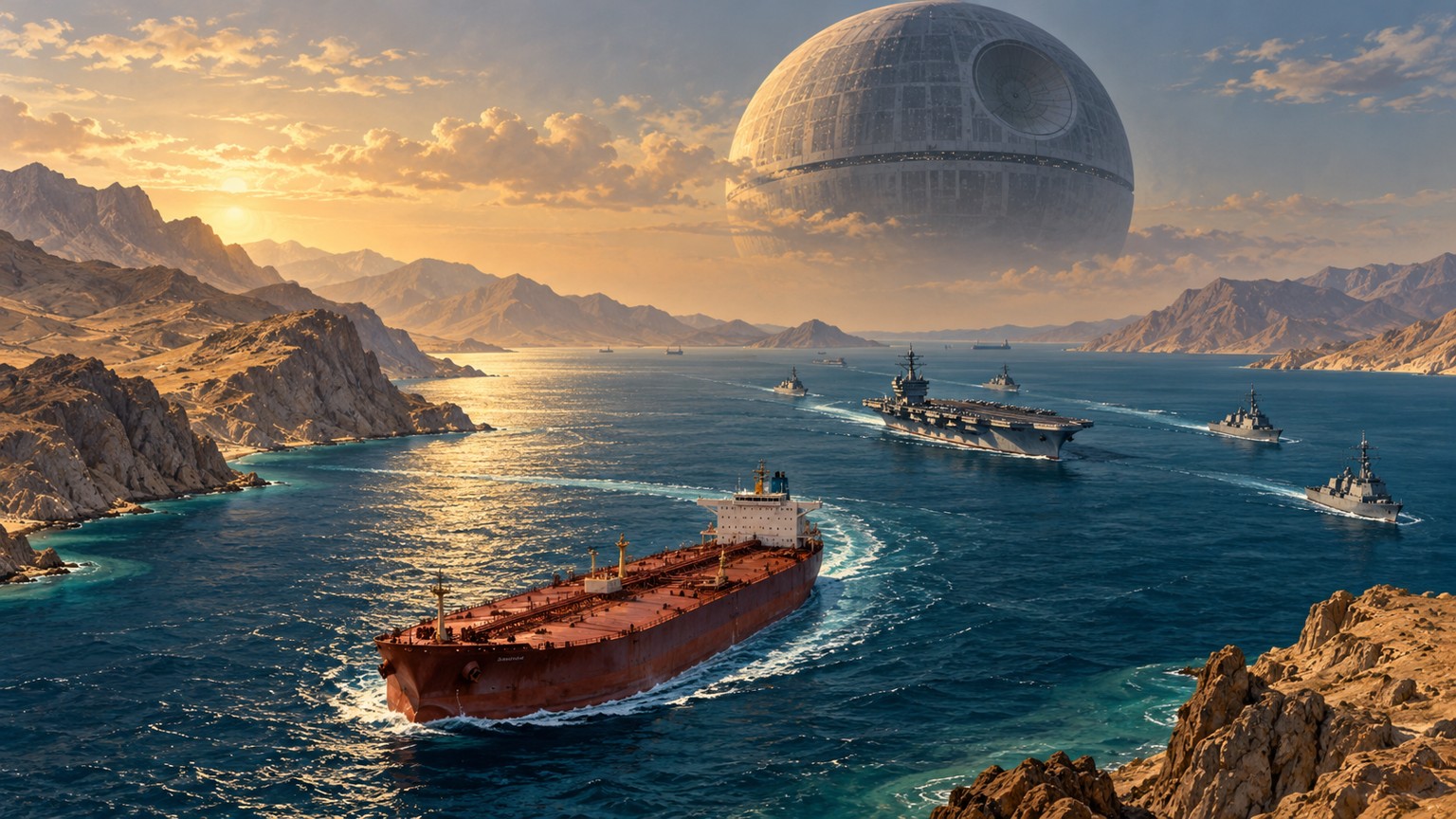
The Death Star could destroy a planet. Keeping a galaxy obedient proved more complicated.
Grand Moff Tarkin, the imperial commander in the original Star Wars, thought he had found a way around the tiresome business of governing. Build a weapon capable of destroying entire worlds, demonstrate what it can do, and let everyone else draw the appropriate conclusion. Beside him stood Darth Vader, ready to give the policy his personal attention.
It is an attractive arrangement for anyone who would rather issue commands than secure cooperation. At the Strait of Hormuz, however, that approach runs into someone with a rather different set of concerns: the shipowner.
The passage between Iran and Oman connects the Persian Gulf to the open ocean. Tankers carry oil and liquefied natural gas through it to international markets. Once a ship is inside the Gulf, there is no other sea exit. Some oil can bypass the strait by pipeline, but a tanker cannot take that detour. [1]
A naval commander looks at the passage and asks whether it can be defended. The owner looks at the same water and asks whether a voyage makes sense. Who will insure it? What will the coverage cost? Will the crew sail? And what happens if the ship gets through this time but cannot safely make the next trip?
The owner has a business to run. The crew has lives to get home to. A declaration that the waterway is open settles only part of the conversation.
Tarkin would recognize what happens next. A missile threatens one vessel; the possibility of another missile changes calculations across an industry. Danger enters an insurance quotation, a contract, a decision to wait. The consequences travel outward through energy markets and supply chains, well beyond the reach of the original weapon.
Iran does not need a Death Star to exploit that relationship. Geography gives a conventionally weaker military opportunities to make life difficult for much stronger opponents. Keeping a passage dependable requires continuing effort. Making it doubtful can take considerably less.
For the power promising to restore order, this creates an awkward problem. You can destroy a great many weapons and still find that people are reluctant to get back to business.
Which brings us to Pete Hegseth.
As head of the Pentagon, Hegseth is both an agent of presidential military power and one of its principal public voices. He is the Vader figure here: the enforcer who carries the executive’s threats into action and presents the results to the rest of us. On April 8, he announced a “decisive military victory” over Iran. At the same briefing, he made clear that American forces would remain to enforce the ceasefire and were ready to resume attacks. [2]
Victory, apparently, still had work to do.
The useful question is what that work was supposed to accomplish. Destroying military capabilities matters. But if dependable commerce is the objective, we also need to know whether owners, insurers, customers, and crews can make ordinary plans again. Their confidence does not follow automatically from a successful strike.
Joseph Nye spent much of his career examining this gap between having impressive resources and getting the results you want. A Harvard political scientist who also served in senior State and Defense Department positions, he understood the appeal of counting what a country possesses. Fleets, money, weapons: these are visible, and they matter. The difficulty comes when possession is mistaken for influence. [3]
Nye’s idea of soft power gives us another way to look at the problem. People may cooperate because you threaten them or offer a reward. They may also cooperate because they find your purposes attractive, trust your leadership, or want to belong to the undertaking. His idea of smart power asks how to combine hard and soft resources effectively. [4]
Think about the difference between an ally who supports an operation and one who has been leaned on to participate. Both may turn up. Keeping them there can be a very different proposition.
At Hormuz, the insurance premium driven upward by the threat of attack is still an effect of coercion. Putting a price on violence does not make it soft power. Nye’s question becomes especially useful when we consider the response: who can bring others into an arrangement they consider worth sustaining?
A warship can protect a voyage. Trusted agreements and shared responsibilities can help make protection less of a permanent emergency.
Meanwhile, the insurer has to decide what danger costs. War-risk coverage provides protection against specified conflict-related losses under the policy’s terms. In March, Reuters reported sharply rising premiums, with quotations varying by vessel and circumstances. Coverage was still available, but the economics of sailing had changed. [5]
That was an early snapshot of the war, not a price list for today. The mechanism remains revealing. Fear does not have to empty the waterway to influence what happens there. It can make each departure more expensive.
Still, it would be a mistake to stop the story at disruption. People adapt, particularly when there is money to be made and oil to be moved.
On October 20, Reuters described a shipping industry improvising around the danger. Producers were using shuttle voyages and transfers between vessels; refiners were turning to smaller tankers and different purchasing arrangements. Those adjustments kept cargo moving while tying up ships and adding costs elsewhere. [6]
The following day, The Wall Street Journal, citing Kpler shipping data, reported that regional oil flows through Hormuz and alternative routes had exceeded prewar levels in the week through October 18. An improvised system under American protection was helping move the oil. Part of that total moved by pipeline around the strait, so it should not be confused with a full recovery of traffic through the strait itself. [7]
Then, on October 23, Reuters reported that the month had already produced the highest attack tally in the Washington Institute’s shipping-incident record, which dates back to 2017. Its researcher had counted 28 confirmed and reported attacks in the strait and nearby waters so far in October. [8]
Oil can keep moving while the danger grows. Commercial recovery does not necessarily mean the underlying conflict has been resolved.
Insurers have been improvising, too. In June, Lloyd’s, the London insurance marketplace, announced a Chubb-led consortium to add war-risk coverage for vessels and cargo using Hormuz, subject to individual assessment and applicable restrictions. [9]
Put those developments together and the contest looks rather more interesting than a scoreboard of destroyed targets. Naval forces provide protection. Businesses rearrange voyages. Insurers spread financial exposure. Diplomats try to create commitments that might eventually reduce the need for all this improvisation.
Force has a role in that effort. So do the relationships that allow people to coordinate it.
Tarkin believed the Empire could dispense with those relationships. When he announced the dissolution of the Senate, he treated the Death Star as a substitute for political mediation. Why bother persuading representatives when fear could do the governing?
Leia’s story exposes the weakness in that confidence. The Empire destroys her home planet, yet the cause she represents survives. The Rebel Alliance has weapons, certainly, but it also has people willing to accept risks for a shared purpose. Its strength depends on attachments the Emperor cannot order into existence.
Vader adds a more uncomfortable dimension. Before the mask, Anakin Skywalker fears losing the people he loves. Palpatine offers power as protection, and Anakin follows that promise into obedience and terrible acts of his own.
We can recognize that bargain without pretending to know Hegseth’s inner life. The question reaches anyone who has accepted another escalation because the last one failed to deliver security. How long do we keep accepting the promise? At what point do we reconsider the person making it?
None of this gives Tehran the moral standing of the Rebel Alliance. Iran’s leaders exercise coercion of their own, abroad and at home. Nor does their capacity to impose costs establish victory. Reuters reported on October 20 that the American blockade and sanctions had also cut off Iran’s oil export revenues and deepened its domestic economic troubles. [10]
Disruption is leverage. What it buys, and what it costs the people living under the government exercising it, are further questions.
Those people are easily lost in the language of strategic endurance. So are the seafarers carrying the cargo and the households absorbing higher prices elsewhere. Leaders demonstrate resolve; a great many other people pay for the demonstration.
These are the relationships I explore in The Empire Strikes Back: how fear becomes authority, how authority secures obedience, and how easily obedience can be mistaken for something more durable.
There is a pleasing complication in using Star Wars to think about them. An American film has given audiences around the world a language for questioning power, including American power. People can admire Leia’s resistance and carry that sympathy into judgments Washington would rather they did not make.
Nye would have appreciated that. Cultural influence travels beyond the government’s instructions.
Hormuz invites us to look past official declarations, too. Watch the ships and the weapons, certainly. But listen to the people deciding whether to sail, insure a cargo, support an ally, or trust a settlement. Much of the story is happening there.
The Death Star promised to make governing simple. The galaxy had other ideas.
So does the shipowner.
Sources
1. U.S. Energy Information Administration, “World Oil Transit Chokepoints”
3. Harvard Gazette, interview with Joseph Nye, May 9, 2017; see also Joseph S. Nye Jr., The Future of Power (PublicAffairs, 2011)
5. Reuters, “Maritime insurance premiums surge as Iran conflict widens,” March 6, 2026
8. Reuters, “Ship attacks in Strait of Hormuz hit record high in October,” October 23, 2026